About the VS Code Dark template
The editor blue that thousands of developers stare at every workday—VS Code Dark brings the familiar comfort of a coder's home environment to your waitlist. When developers see that palette, they're already in the right headspace to commit. No friction, no learning curve—just the interface they know deepened into a signup form. Developers will beta-test your launch without hesitation.
What the demo shows
The live demo on this page launches Tabstop School, a made-up product we wrote to show the template with realistic copy: the headline reads “Learn to code after the kids sleep” and the subhead says “Tabstop School runs live, part-time evening cohorts where working adults build real projects with a mentor reviewing every commit.” Below it you see the signup form, a demo launch countdown and the share-to-climb referral panel exactly as a visitor would. Try the form: in the demo nothing is stored. When you use VS Code Dark, you replace Tabstop School with your own product name, headline, subhead and logo; the palette and motion come with it and every colour stays editable.
Design details
VS Code Dark is a dark template: a charcoal background (#1e1e1e), light grey type (#d4d4d4) and a sky blue accent (#569cd6) on the join button, the countdown and the referral highlights. Body text sits at a 11.2:1 contrast ratio against the background, comfortably past the WCAG AAA threshold. Behind the copy the page animates with an animated code editor layer, front and centre; visitors who ask their device for reduced motion get a still frame instead. Structurally it uses the Cyber-Glitch layout, shared with 84 other templates, but the palette, the motion and the demo copy are VS Code Dark's own.
- Background
- #1e1e1e
- Accent
- #569cd6
- Text
- #d4d4d4
How it compares
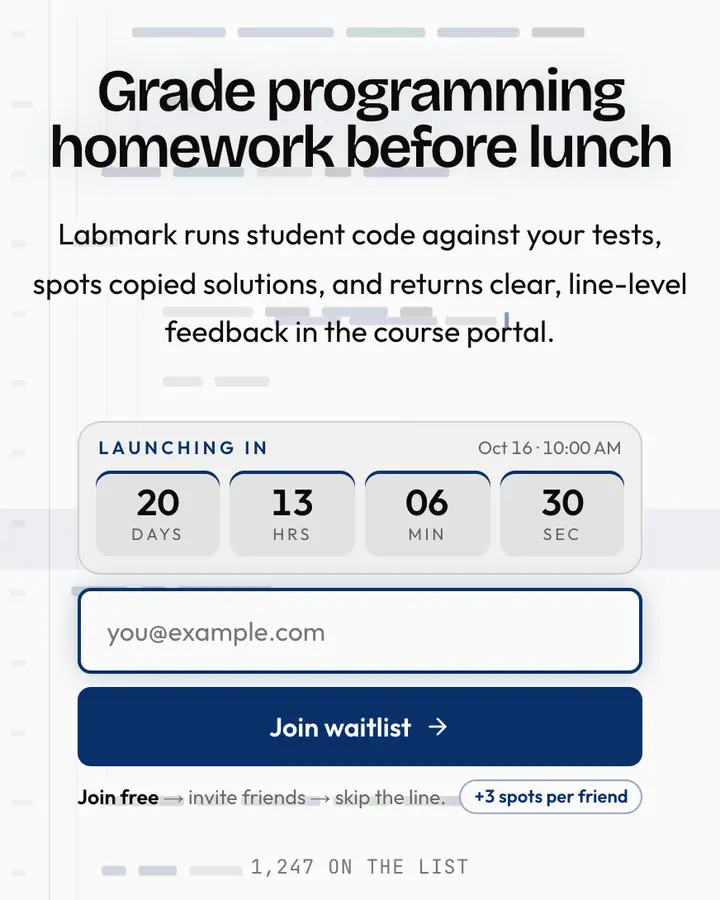
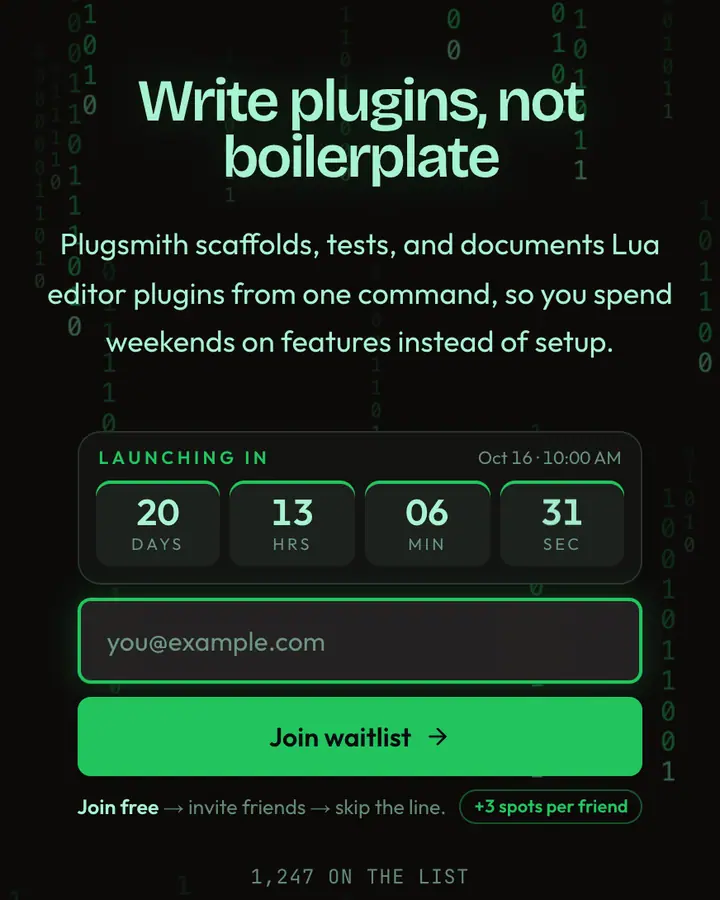
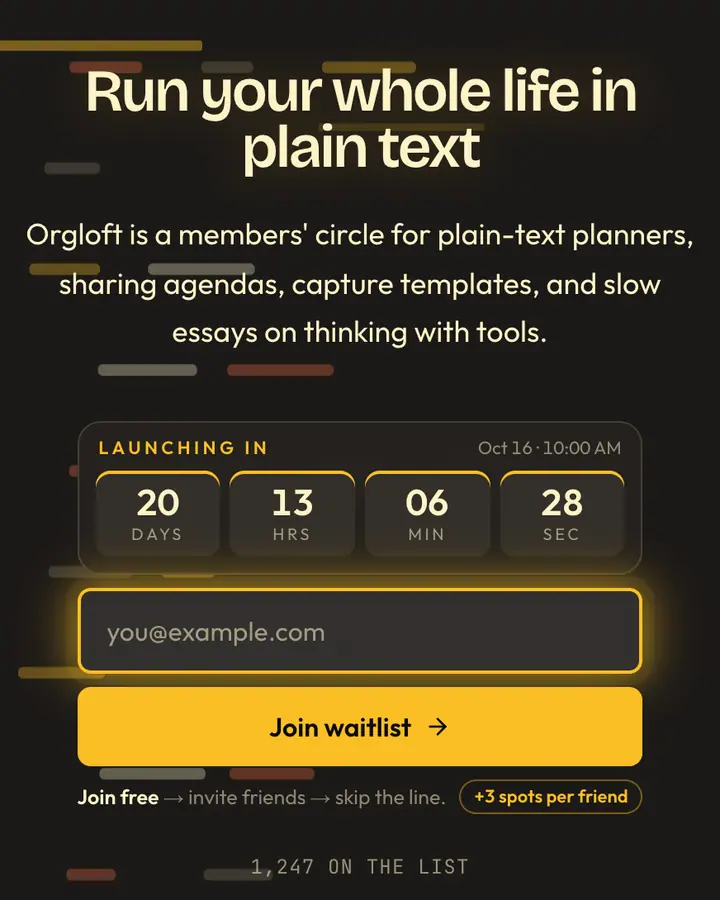
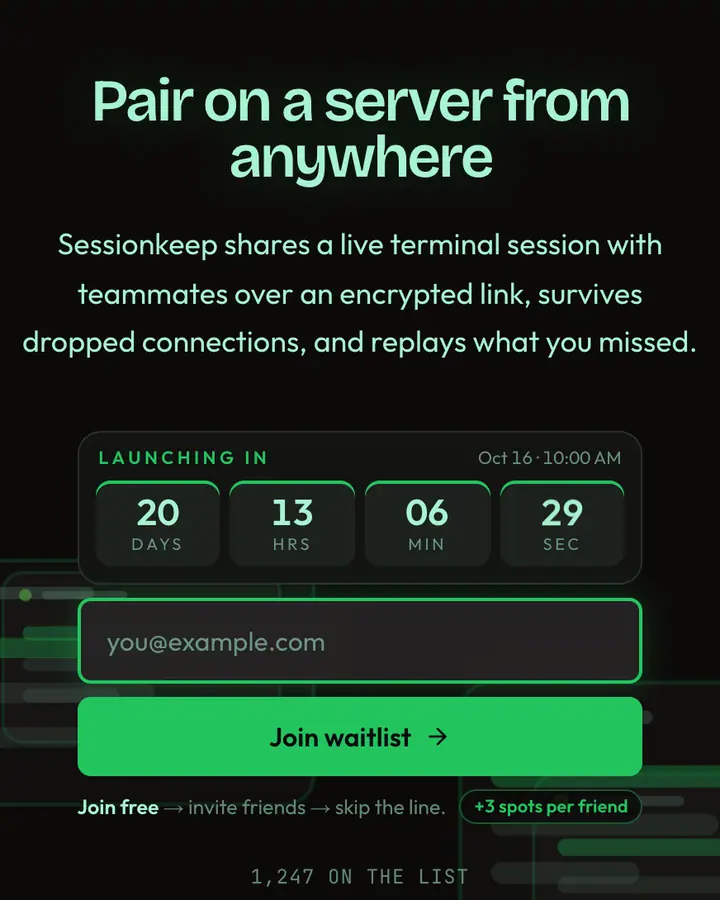
Within Terminal, VS Code Dark stands out for its sky blue accent on a charcoal ground. If it is not quite right, VS Code Light flips to a light white canvas with a dark blue accent and an animated code editor layer (“Crisp light, syntax cool”). Neovim Lua is also dark but leans on an emerald accent and cascading glyph rain (“Lua green, modal edit”). Emacs Buffer is also dark but leans on a vivid amber accent and scrolling terminal output (“Org-mode amber, M-x”). All of them share the same signup, referral and analytics features, so switching later only changes the look.
Launch with VS Code Dark in three steps
- Click “Use this template” and create a free account; VS Code Dark is preselected in the page wizard.
- Replace the Tabstop School demo copy with your product's headline and one-line pitch, pick a URL, and optionally set a launch date to show a real countdown.
- Publish and share the link. Every subscriber gets a personal referral link, and you watch signups and top referrers arrive in the dashboard.